(John 5:1–15)
Beloved in Christ,
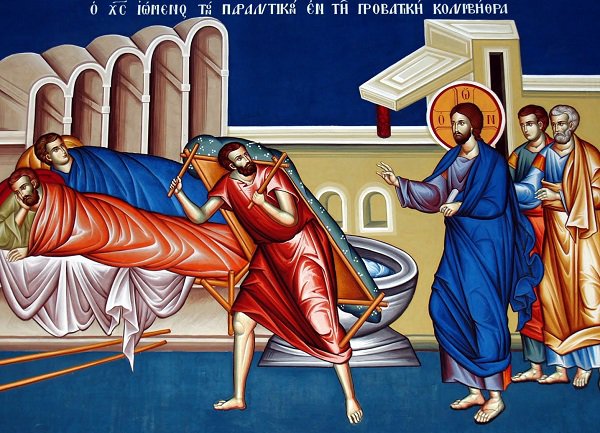
Today, the Church leads us to the Sheep Gate, to the pool called Bethesda, where many lay in weakness—blind, lame, and paralyzed—waiting for the stirring of the waters. Yet among them lay one man, thirty-eight years bound by infirmity, stretched upon his bed as upon a silent cross, his years heavy with disappointment, his hope worn thin by waiting.
And behold—Christ comes to him.
Not summoned.
Not entreated.
Not demanded.
The Lord approaches the one who cannot rise, the one who cannot reach the water, the one who has no man to help him. The paralytic does not cry out like Bartimaeus, nor climb like Zacchaeus, nor weep like the woman with the issue of blood. He lies still. And yet—Christ sees him.
This, beloved, is the mercy of God:
that before we seek Him, He seeks us.
The Lord asks a question that pierces the heart:
“Do you want to be made well?”
Not because Christ does not know the answer, but because He desires the healing of the will before the healing of the body. For there are wounds we grow accustomed to, chains we mistake for shelter, sicknesses we fear to lose because they have become our identity.
The paralytic answers not with faith, but with sorrow:
“I have no man to put me into the pool.”
He speaks the truth of fallen humanity—alone, abandoned, unable to save itself. And Christ does not rebuke him. He does not require a confession of doctrine or a declaration of worthiness.
Instead, the Word who once said “Let there be light” now says:
“Rise. Take up your bed and walk.”
At once, the command becomes power.
The word becomes strength.
The bed of weakness becomes a testimony.
O wonder! The man who was carried now carries. The place of his shame becomes the sign of his healing. Christ does not merely restore him—He reverses his story.
And yet, beloved, the healing is not the end.
Later, in the Temple, Christ finds him again and says:
“Sin no more, lest something worse befall you.”
Thus, the Lord teaches us that bodily healing is a mercy, but healing of the soul is the greater gift. For what profits a man to walk in strength, yet remain paralyzed by sin? What good is a restored body if the heart still lies motionless before God?
Today’s Gospel is proclaimed in the days after Pascha, when the Church still sings, “Christ is risen!” For this miracle is not merely about one man—it is about us.
We are the paralytic.
We have lain long years in habits that bind us, fears that weaken us, sins that drain our strength. We wait for circumstances to change, for others to help us, for the waters to move—yet Christ stands before us now.
He asks us the same question:
Do you want to be made well?
If we answer with humility, He answers with power.
If we cannot rise on our own, He raises us.
If we cannot walk, He becomes our strength.
Let us then rise from the bed of complacency.
Let us carry away the memory of our former weakness.
Let us walk—not back to the pool, but forward into the life of repentance and thanksgiving.
For Christ has come—not only to stir the waters, but to heal the whole world.
To Him be glory, together with His eternal Father and the all-holy, good, and life-creating Spirit, now and ever, and unto ages of ages.
Amen.